 A Canadian community service organization handles client information at every stage of service delivery. From intake forms and case notes to referrals, uploaded documents, and funder reports, each interaction raises questions about how personal information should be managed and protected.
Protecting client data goes beyond cybersecurity. It involves deciding what information to collect, who can access it, how long it should be retained, when it can be shared, and how records remain accurate. Strong privacy and data governance practices help nonprofits manage these responsibilities while maintaining client trust.
This guide explains the Canadian nonprofit privacy landscape, including applicable privacy laws, practical data protection strategies, and responsible data governance practices for human services organizations.
This article is educational and is not legal advice. Which rules apply depends on the province, organizational activities, the type of information held, and funding or contractual relationships. Confirm specific obligations with qualified legal counsel or the relevant privacy commissioner's office.
At a Glance
Canadian nonprofits protect client data through clear collection purposes, appropriate access controls, retention policies, secure information sharing, and documented privacy responsibilities. Legal requirements vary by province, organizational activity, and sector. PIPEDA does not automatically apply to every nonprofit, but provincial privacy laws and sector-specific requirements may still govern how personal information is handled.
What Is Nonprofit Data Governance?
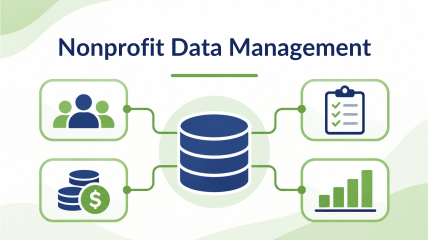
Data governance is how an organization makes consistent decisions about its information. It sets out who is responsible, which rules apply, and how those rules are followed, from the moment information is collected to the moment it is no longer needed.
Data governance is broader than cybersecurity. Security asks how to prevent unauthorized access. Data governance asks that question too, and then goes further:
- Why is this information collected?
- Who needs access to it?
- How should each field be defined and recorded?
- How long should it be retained?
- What uses are appropriate?
Privacy, security, and data governance are closely connected but serve different purposes. Privacy guides how personal information is handled, security protects that information, and data governance establishes the policies and responsibilities that bring both together.

Why Is Client Data Privacy Important for Canadian Nonprofits?
Nonprofits and community service organizations often hold information that people share at difficult moments in their lives. Depending on the programs an organization runs, that can include:
- Personal and household information: Names, contact details, family circumstances, and demographics.
- Financial and employment information: Income, benefits, employment history, and financial assistance.
- Housing and immigration information: Housing circumstances, immigration status, and related documentation.
- Health and disability information: Medical details, disabilities, and support needs.
- Client service records: Case notes, assessments, referrals, uploaded documents, and service history.
Not every organization collects all of these, and a food bank has very different needs from a settlement agency or a youth housing program. What they share is that inappropriate access or disclosure can have real consequences, especially for people who are already navigating vulnerable circumstances.
A disclosed address, a misplaced assessment, or a case note seen by the wrong person can affect safety, housing, employment, and a person's willingness to seek help again.
The goal is not to treat every record with alarm. It is to match the care an organization takes to the sensitivity of what it holds.
What Privacy Laws Apply to Canadian Nonprofits?
Canada does not have one privacy rule that applies identically to every nonprofit. Several federal and provincial frameworks exist, and which ones apply depends on where the organization operates, what it does, and what kind of information is involved.
That means the right question is not "Does every nonprofit have to follow PIPEDA?" The right question is:
Which privacy requirements apply to the organization and the information it handles?
PIPEDA
The Personal Information Protection and Electronic Documents Act (PIPEDA) is Canada's federal private-sector privacy law. It applies to organizations that collect, use, or disclose personal information in the course of commercial activities.
The Office of the Privacy Commissioner of Canada (OPC) explains that non-profit organizations are usually not subject to PIPEDA because they do not typically engage in commercial activities. That includes most charities, community groups, clubs, and advocacy organizations. Nonprofit status does not automatically exempt an organization. For example, selling, bartering, or leasing a membership list or donor list is considered a commercial activity.
In practice, this means:
- Most ordinary nonprofit activities, such as delivering programs and managing client files, are not automatically subject to PIPEDA simply because personal information is involved.
- A particular commercial activity, such as the sale of a donor list or a fee-based service that is commercial in character, may fall within PIPEDA. Ordinary fundraising is not necessarily commercial activity.
- Whether an activity is commercial depends on the facts, so organizations with fee-for-service lines, social enterprises, or data-sharing arrangements involving payment should look at those activities specifically.
How Do Provincial Privacy Laws Apply to Nonprofits?
Provincial legislation can matter a great deal. Alberta, British Columbia, and Quebec each have a general private-sector privacy law that has been deemed substantially similar to PIPEDA. In general, organizations subject to one of those laws follow it for personal information handled within the province, while PIPEDA can still apply to information that crosses provincial or national borders in the course of commercial activities.
How these laws reach nonprofits differs by province. The following table summarizes common frameworks, not every applicable law or exception.
In Alberta, the organization's legal structure can affect whether PIPA applies fully or only to its commercial activities. In British Columbia, PIPA generally reaches nonprofits and charities without relying on a commercial-activity test. In Quebec, the private-sector statute applies to persons carrying on an enterprise, which can include some nonprofit operations. Law 25 strengthened this framework through governance duties, privacy impact assessments, and confidentiality-incident rules.
Some provinces have separate personal health information legislation. Ontario's Personal Health Information Protection Act (PHIPA) and Alberta's Health Information Act are examples. A nonprofit's obligations can depend on whether it is a health information custodian, an agent, or another covered participant in a regulated arrangement.
Ontario also has privacy and access rules under Part X of the Child, Youth and Family Services Act, 2017 for covered child, youth, and family service providers. Ontario does not have a general private-sector privacy law equivalent to BC PIPA, although PIPEDA and sector-specific laws can apply.
There is no need to master every statute. The practical task is to identify the laws that touch your organization and confirm them with your provincial privacy commissioner's resources or legal counsel.
Other Organizational Contexts
The OPC notes that municipalities, universities, schools, and hospitals are generally covered by provincial laws. Public institutions and organizations expressly covered by legislation may operate under provincial access and privacy statutes, such as Ontario's Freedom of Information and Protection of Privacy Act (FIPPA) and Municipal Freedom of Information and Protection of Privacy Act (MFIPPA). Government funding alone does not automatically make an independent nonprofit an institution under these statutes.
Nonprofits that deliver services on behalf of governments, health authorities, or school boards should also review their funding and service agreements. Those agreements can import privacy, security, and reporting requirements even when no statute applies directly to the nonprofit.
Federal Reform Is Under Way
As of November 19, 2026, Bill C-36, introduced on June 15, 2026, remains at second reading in the House of Commons and has not become law. The bill proposes to enact the Protecting Privacy and Consumer Data Act and replace Part 1 of PIPEDA. Its provisions may change during the legislative process. Current obligations should be checked against the law in force, not proposed legislation.
Privacy Principles That Help Even When PIPEDA Does Not Apply
The OPC notes that organizations not directly covered by PIPEDA can still benefit from its fair information principles as best practices. Those principles have shaped privacy laws across Canada, so building around them prepares an organization for most of the frameworks it may meet.
In operational terms, they look like this:
- Accountability. A named person or team is responsible for how client information is handled, and staff know who that is.
- Identifying purposes. The organization can say why each important piece of information is collected, before it is collected.
- Consent, where required or appropriate. Explain why information is collected or used, and obtain valid consent when the applicable legal framework requires it. Some laws provide other lawful bases or exceptions.
- Limiting collection. Staff collect what the program needs, not everything that might someday be useful.
- Limiting use, disclosure, and retention. Information is used for the purposes it was collected for, shared only through defined channels, and kept only as long as needed.
- Accuracy. Records are correct, current, and easy to fix.
- Safeguards. Protections match the sensitivity of the information.
- Openness. The organization explains its practices in language clients can understand.
- Individual access. People can ask to see their information and request corrections.
- Challenging compliance. There is a clear way to raise a concern and a person who responds.
The sections below turn these principles into everyday practice.
Collect Only the Information You Need
Data minimization means collecting the information your programs actually require, and being able to explain why. Strong reasons for collecting a piece of information include:
- Determining eligibility
- Coordinating services
- Documenting service delivery
- Measuring outcomes
- Meeting reporting requirements
- Communicating with clients
- Fulfilling legal or contractual obligations
The weakest reason is "It might be needed someday." Information collected without a purpose is still information that must be secured, kept accurate, answered for, and eventually disposed of. It increases the impact of any incident and adds work for staff without improving service.
A useful exercise is to review an intake form field by field. For each one, ask what decision it supports, who uses it, and what would happen if it were removed. Fields with no good answer are candidates for removal or for being made optional. A well-designed client intake process is one of the most effective privacy measures an organization can take, because it sets the boundaries of everything that follows.
Be Clear About Why Information Is Collected
Clients should be able to understand, in plain language, what information is being collected and what it will be used for. This is less a legal exercise than a trust-building one.
Staff need to understand these distinctions, particularly when collecting information for a nonprofit needs assessment. Suppose a program collects demographic information for program evaluation and funder reporting rather than eligibility decisions. Staff should understand that purpose and be able to explain it to clients.
Practical habits that support transparency include:
- A short, readable privacy notice at intake, in the languages your community uses
- Scripts or talking points that help staff explain why a question is being asked
- Clear indication of which questions are required and which are optional
- A plain explanation of who inside and outside the organization may see the information
What consent is required, and what form it must take, depends on the laws, agreements, and program rules that apply to you. Treat those as questions for your privacy lead or legal counsel.
Control Access Based on Roles
Not everyone in an organization needs access to every piece of client information. This is especially important for sensitive documentation, including case management notes, which may contain personal histories, assessments, and service details. Limiting access based on staff responsibilities is one of the most practical safeguards available and reduces the risk of inappropriate disclosure.
Consider how different roles use information:
- A housing case manager needs detailed housing, assessment, and service information for the clients on their caseload.
- A finance employee may need payment and funding information, but not detailed case notes.
- A program manager may need aggregate program reporting and the ability to review specific files for supervision or quality assurance.
- Executive leadership may need organization-wide dashboards without unrestricted access to every client record.
This approach is often called role-based access, or access based on a "need to know." In practice it involves:
- Defining roles and the categories of information each role can view, create, edit, or export
- Granting access when someone starts, changing it when they move roles, and removing it promptly when they leave
- Reviewing who has access on a regular schedule
- Keeping an audit trail so the organization can see who viewed or changed a record
- Applying extra restrictions to especially sensitive records, such as those involving safety concerns
The right access model depends on your programs and the sensitivity of your information. No specific model is universally required by law, but a documented, role-based approach is a widely recognized way to show that access decisions are deliberate.
Consider Cross-Program Access Carefully
Many nonprofits run several programs. In human services case management, one client might receive housing assistance, employment services, emergency food support, family support, and referrals to outside providers.
That creates a real tension. Sharing information across programs can improve coordination, reduce the number of times clients repeat their stories, and help staff see the full picture. At the same time, a client who shared something with an employment counsellor may not expect it to be visible to everyone in the housing program.
Good data governance helps an organization decide:
- What information should be shared across programs
- With whom
- For what purpose
- Under what circumstances
One approach is to separate a small set of core information that supports coordination, such as contact details and active services, from program-specific details such as case notes and assessments, which stay restricted to the team that needs them. Another is to give clients a clear explanation, at intake, of what is shared across programs and why.
When disclosure is permitted, and what authorizations are needed, depends on the laws, funding agreements, and program requirements that apply to you. Develop cross-program policies with those in mind, and confirm them with legal counsel where the answer is not clear.
Maintain Accurate Client Information
Privacy is also a data quality issue. Information that is wrong, outdated, or duplicated can affect eligibility decisions, services, referrals, reporting, and communication with clients. A mismatched record can lead to a message sent to the wrong person or a file merged with someone else's.
Practical steps include:
- agreeing on how names, dates, addresses, and other key fields are entered
- checking for existing records before creating a new one, to reduce duplicates
- giving clients a simple way to ask for corrections, and recording when a correction is made
- reviewing and cleaning records periodically
- assigning someone to own data quality for each program
These habits are the foundation of sound nonprofit data management, and they make every other privacy practice easier.
Establish Retention and Disposal Practices
Keeping information forever is not automatically safer. The longer records are kept, the longer they remain exposed to risk and the more work it takes to keep them accurate.
Organizations should define:
- What information must be retained
- Why it must be retained
- For how long
- When it can be archived
- When it should be securely deleted or destroyed
There is no single retention schedule that applies to every nonprofit dataset. Retention requirements can come from legal obligations, contracts, funding agreements, program rules, professional standards, and the organization's own operational needs. Different categories of records, such as financial records, case files, and intake forms for services never delivered, may have different periods.
Build your schedule from those sources, document it, and apply it consistently. Disposal procedures should address copies in exports, spreadsheets, shared drives, and backups, taking account of applicable retention obligations, backup lifecycles, and secure deletion processes.
Sharing Information With Partners and Service Providers
Nonprofits routinely share or provide access to client information through:
- Referral partners
- Service providers and consultants
- Software vendors and cloud platforms
- Funders
- Government programs
For each arrangement, an organization should understand:
- What information is being shared
- Why it is being shared
- What the receiving organization can do with it
- How it will be protected
- Which contractual or privacy requirements apply
Written agreements help. Data-sharing agreements and vendor contracts can set out purposes, access limits, security expectations, subcontractors, incident notification, and what happens to the data when the relationship ends. Share the minimum needed, and prefer aggregate or de-identified information where it meets the need, particularly for funder reporting.
Whether a given disclosure is permitted is a legal question that depends on your circumstances, so route those questions to your privacy lead or counsel.
Do Canadian Nonprofits Need to Store Data in Canada?
These terms come up often when Canadian organizations evaluate software, and they are not interchangeable.
Data residency refers to where data is physically stored, such as a data center located in Canada.
Data sovereignty refers to the legal jurisdiction and governance framework that can affect data. Information stored in one country may still be subject to the laws, and potentially the legal demands, of another jurisdiction, depending on who operates and controls the service.
The two are related but not identical. Data can be stored in Canada and still be managed by a provider whose parent company is subject to foreign law, and data stored abroad can be protected by strong contractual and technical controls.
Canadian nonprofits are not universally required to store all data physically in Canada. Whether a data residency requirement applies depends on provincial laws, the organization's sector, the type of information involved, and any applicable funding agreements, government contracts, or internal policies.

Some frameworks address cross-border handling directly. Alberta's PIPA requires organizations that use service providers outside Canada to include certain details in their policies and to notify individuals in specific circumstances. Under Quebec's private-sector law, covered organizations must conduct a privacy impact assessment before communicating personal information outside Quebec or entrusting certain information-handling activities to a provider outside Quebec. The law sets conditions for proceeding, including consideration of the destination's legal framework and an appropriate written agreement. Certain projects to acquire, develop, or overhaul information systems involving personal information also require an assessment.
When evaluating a cloud platform, useful questions include:
- Where is the data stored, and where are backups kept?
- Who can access it, including support staff and subcontractors, and from where?
- Which legal jurisdictions could apply to the provider?
- What security certifications and independent assessments does the provider hold?
- What happens to the data when the contract ends?
- Does the provider meet any residency requirements in applicable funding or government agreements?
These questions are also relevant when evaluating case management software, and asking them early can prevent costly surprises later.
What Is Canada's CAN/DGSI 100-11 Data Governance Standard?
Canadian community organizations now have sector-specific guidance. CAN/DGSI 100-11:2025, Data Governance, Part 11: Community and Human Services is a National Standard of Canada developed by the Digital Governance Standards Institute (DGSI), part of the Digital Governance Council. The Standards Council of Canada lists it as published in 2025.
The standard specifies minimum requirements for the responsible and privacy-preserving collection, storage, use, and sharing of personal information by organizations that deliver community and human services. It also offers a reference point for funders, service providers, and technology partners involved in handling community-service information. It was developed with a volunteer technical committee that included nonprofit sector organizations such as the Ontario Nonprofit Network and the Canadian Mental Health Association. The Digital Governance Council also provides an implementation checklist, and its Impact Ready program offers a way to assess and demonstrate data governance practices against the standard.
Why does it matter? Because it shows that responsible data governance is becoming a more formal expectation for Canadian nonprofits and community service providers, and it gives the sector a shared reference point for what good practice looks like. Funders, partners, and clients may increasingly ask about it.
A standard is not legislation. CAN/DGSI 100-11:2025 is not automatically legally mandatory, and it does not replace the privacy laws that apply to your organization. Think of it as a best-practice framework that organizations can adopt voluntarily, unless a funder or contract requires it. Review the current official text before relying on any summary, including this one.
Prepare for Privacy and Security Incidents
Every organization that holds personal information should assume that an incident will eventually happen: a laptop is lost, an email goes to the wrong recipient, a staff member looks at a file they should not, or a vendor reports a breach. Preparation determines whether the response is calm and effective or improvised.
An incident response plan should cover:
- How staff recognize and report a possible incident, and to whom, without fear of blame
- Who leads the response and who makes decisions
- How the incident is contained and investigated
- How the organization assesses the risk of harm to the people affected
- When and how affected individuals, funders, partners, and regulators are notified
- How incidents and lessons learned are recorded
Notification duties depend on the law that applies. For example:
- In Alberta, organizations subject to PIPA must notify the Commissioner without unreasonable delay when a loss of, or unauthorized access to or disclosure of, personal information creates a real risk of significant harm.
- In Quebec, a person carrying on an enterprise must notify the Commission d'accès à l'information and affected individuals promptly when a confidentiality incident presents a risk of serious injury, and must keep a register of confidentiality incidents.
- Other frameworks, including PIPEDA where it applies and provincial health privacy laws, have their own reporting rules and thresholds.
Funding agreements and vendor contracts may also require notice within a set period. Know these obligations before an incident, not during one, and rehearse the plan with a tabletop exercise at least once a year.
Build Governance Policies and Clear Staff Responsibilities
Policies matter only if people know them and can follow them. A practical governance foundation includes:
- A Named Lead: Designate someone accountable for privacy and data governance. In a small organization this may be part of a role. Under Quebec's private-sector privacy law, the person exercising the highest authority is responsible for protecting personal information, although this function can be delegated in writing. The applicable contact information must also be made available.
- A Short Set of Core Policies: Typically a privacy policy, an access control policy, a retention and disposal schedule, an incident response plan, and guidance for data sharing and vendor review.
- A Public-Facing Privacy Notice: A plain-language privacy notice explaining what is collected, why it is needed, and how to contact the person responsible.
- Onboarding and Annual Training: Staff and volunteers should learn what is sensitive, what they may access, how to handle requests, and how to report an incident.
- Regular Reviews: Revisit policies when programs, systems, funders, or laws change.
- Board Oversight: Boards do not need technical detail, but they should receive periodic reporting on privacy risks and incidents.
Start small. A concise policy that staff actually use is more valuable than a long one no one reads.
How Technology Can Support Privacy-Conscious Data Management
Technology cannot create good governance, but the right system makes good practices easier to follow. When evaluating a case management or data management platform, look for capabilities such as:
- Role-based permissions that can be tailored to programs and record types
- Audit logs that show who viewed, created, edited, or exported information
- Configurable intake forms, so required and optional fields reflect your purposes
- Tools to find and merge duplicate records
- Support for consent and information-sharing preferences
- Controls over exports and reports
- Retention and archiving features
- Clear documentation of hosting location, security practices, and subcontractors
- Reporting that supports aggregate outcomes without exposing individual files
A centralized platform can also reduce the risks that come with scattered spreadsheets, shared inboxes, and unmanaged copies. Ask any vendor to explain, in writing, how its product and hosting arrangements address your specific legal, funder, and organizational requirements.
Where to Start
You do not need to address everything at once. A sensible first sequence is:
Sources and Further Reading
This article draws on official Canadian privacy and data governance sources. Verify current requirements directly with the relevant regulator or official body.
Federal privacy guidance
- Office of the Privacy Commissioner of Canada: How PIPEDA applies to charitable and non-profit organizations
- Office of the Privacy Commissioner of Canada: Summary of privacy laws in Canada
- Parliament of Canada: Bill C-36 status
Provincial privacy guidance
- Government of Alberta: Personal information for non-profits and other organizations
- Office of the Information and Privacy Commissioner for British Columbia: PIPA and private organizations
- Information and Privacy Commissioner of Ontario: Part X of the Child, Youth and Family Services Act
- Gouvernement du Québec, LégisQuébec: Act respecting the protection of personal information in the private sector (P-39.1)
Data governance standard
- Digital Governance Council: CAN/DGSI 100-11:2025
This article is provided for general educational purposes and is not legal advice. Privacy requirements vary by province, sector, activity, and agreement, and they change over time.