
 A client seeking mental health counseling may also need housing assistance, financial support, or help accessing community resources. Providing coordinated services often means that multiple professionals need access to information about the same individual.
But how can nonprofit and human services organizations ensure that sensitive information reaches the right people without exposing more than necessary?
Protecting client information is an essential part of delivering effective services. Staff need reliable information to coordinate care, document progress, manage programs, and support clients. At the same time, organizations must establish clear boundaries around who can access records, how information is shared, and what should be included in reports.
When the Health Insurance Portability and Accountability Act (HIPAA) applies, these practices are also part of an organization's legal responsibilities. However, HIPAA is only one consideration within the broader landscape of nonprofit data privacy and confidentiality. Understanding how privacy requirements intersect with everyday workflows can help organizations protect sensitive client information without creating unnecessary barriers to service delivery.
How Does HIPAA Apply to Human Services Case Management?
HIPAA establishes federal standards for protecting certain health information. Its Privacy and Security Rules apply to covered entities, including qualifying health care providers, health plans, and health care clearinghouses, as well as applicable business associates.
However, not every nonprofit or human services organization is subject to HIPAA.
A nonprofit operating a behavioral health clinic that conducts covered electronic transactions may be a covered entity. Another organization providing housing assistance or workforce development services may collect sensitive health information without independently qualifying as a HIPAA-covered entity.
Organizations providing services on behalf of covered entities may also have responsibilities as business associates, depending on the nature of their activities and access to protected health information (PHI).
The distinction matters because collecting sensitive information does not automatically make an organization subject to HIPAA. Even when HIPAA does not apply, state privacy laws, contractual obligations, professional standards, and other confidentiality requirements may still govern how information is handled.
For organizations that provide multiple services, understanding which requirements apply to particular programs and records is an important part of developing consistent data management practices.
Protecting Client Information Throughout the Case Management Process
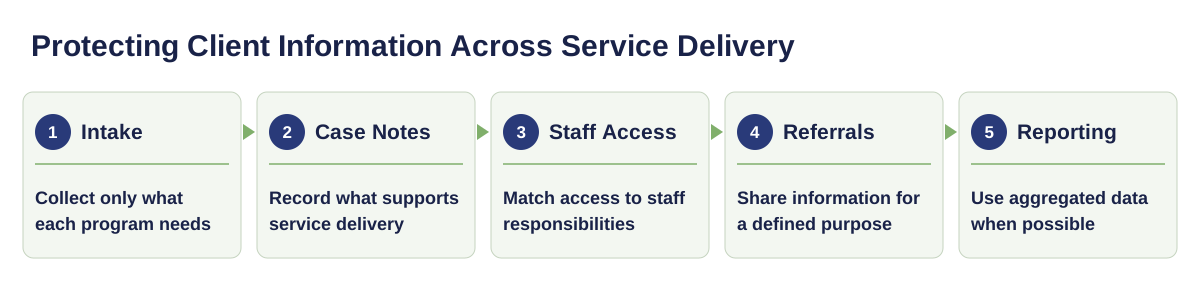
Privacy considerations do not begin and end with secure record storage. They arise throughout the client lifecycle, from the first intake conversation to ongoing service coordination and program reporting. The following examples illustrate how organizations can approach these challenges in everyday workflows.
1. Client Intake: Collecting and Organizing Sensitive Information
Client intake often establishes the foundation for an individual's entire service history. Depending on the program, staff may collect demographic information, medical histories, insurance details, emergency contacts, assessments, and supporting documentation. Different programs need different information.
For example, a counseling program may require clinical information that would not be relevant to a housing assistance application. Using the same intake form across every program can create unnecessary data collection and make it harder to distinguish information that different staff members need.
A more deliberate client intake process allows organizations to tailor forms to specific services, communicate applicable privacy practices, and collect required acknowledgments or authorizations when appropriate.
Organizations should also consider where submitted information goes after intake. Sensitive documents should be directed to the appropriate records and made accessible only to authorized personnel.
2. Case Notes: Balancing Documentation and Confidentiality
Case notes are essential to maintaining continuity of care and documenting services. They may describe client interactions, identified needs, referrals, treatment progress, and follow-up activities. However, not every detail discussed during a session necessarily belongs in a shared case record.
Consider a case manager who meets with a client receiving both counseling and financial assistance. Staff coordinating financial support may need to know whether assistance was approved and what follow-up is required. They may not need access to the client's detailed clinical history.
Clear standards for case management notes help staff document information relevant to service delivery while avoiding unnecessary disclosure of sensitive details. Organizations should also distinguish general clinical progress notes from psychotherapy notes, a specific category of separately maintained records that receives additional protections under HIPAA.
Effective documentation practices therefore involve more than recording information accurately. They also require thoughtful decisions about what belongs in each record and who needs access to it.
3. Staff Access: Making Information Available to the Right People
Human services organizations often bring together professionals with different responsibilities. A single agency may employ therapists, case managers, intake coordinators, billing specialists, and program administrators. Although these individuals may support the same client, their information needs are not necessarily identical.
HIPAA's minimum necessary standard generally requires covered entities to make reasonable efforts to limit uses, disclosures, and requests for PHI to what is needed for the intended purpose, subject to important exceptions. Within an organization, role-based access policies can help establish which staff members are authorized to view particular information.
For example, a billing specialist may need access to insurance information and payment records without requiring unrestricted access to every clinical note. A program administrator may need service activity data without needing to review individual treatment histories. Configurable permissions can help organizations reflect these distinctions in their daily workflows.

The objective is not to make information difficult to access. It is to ensure that employees can perform their responsibilities while reducing unnecessary exposure of sensitive records.
4. Referrals and Service Coordination: Sharing Information Responsibly
Coordinating services frequently requires organizations to communicate with outside providers. A behavioral health provider might refer a client to a housing organization, while a case manager may coordinate services with a medical provider or another community agency.
These exchanges raise important questions about what information can be shared, with whom, and for what purpose.
HIPAA generally permits covered health care providers to disclose PHI for treatment and certain care coordination activities without obtaining a separate HIPAA authorization. However, the applicable permissions depend on the circumstances, and additional laws may impose stricter requirements.
Not every referral requires a business associate agreement, and not every information-sharing arrangement qualifies as a treatment disclosure. Organizations therefore need established procedures for evaluating disclosures, documenting permissions or authorizations where required, and communicating through appropriately protected channels.
Well-defined referral workflows can help staff coordinate services while maintaining accountability for how client information moves between organizations.
5. Reporting: Demonstrating Outcomes While Protecting Privacy
Case management information serves purposes beyond individual service delivery. Organizations also use client records to evaluate programs, prepare funding reports, monitor service utilization, and demonstrate outcomes to stakeholders.
The challenge is transforming detailed client information into meaningful organizational insights without unnecessarily exposing identifiable records. For example, a nonprofit may want to report how many participants completed counseling services or achieved a particular program outcome. In many situations, summary statistics may be sufficient without including names or individual case histories.
However, removing names alone does not necessarily make health information de-identified under HIPAA. The Privacy Rule establishes specific methods for de-identification, including Safe Harbor and Expert Determination. Organizations should consider reporting requirements and privacy protections together when designing their data collection and reporting processes.
This makes it possible to produce useful program information while reducing the risk of inappropriate disclosure.
How Case Management Software Can Support Data Privacy
As organizations expand their services, maintaining consistent privacy practices across separate spreadsheets, documents, databases, and communication channels can become increasingly difficult. A centralized case management system can help establish a more consistent approach to collecting, organizing, accessing, and reporting client information.
Depending on its capabilities and configuration, software may support:
- Role-based permissions that distinguish access needs across teams and programs.
- Configurable intake and documentation workflows that accommodate different types of services and information.
- Activity and audit records that help authorized personnel review system activity.
- Secure document management that keeps supporting information organized within appropriate client records.
- Reporting tools that allow organizations to evaluate services without unnecessarily distributing individual records.
These capabilities can support privacy and security practices, but technology alone does not establish HIPAA compliance.
Covered entities and business associates must also address applicable administrative and physical safeguards, risk assessments, workforce training, policies, vendor relationships, and ongoing oversight. The most effective approach combines appropriate technology with clear operational responsibilities.
Building Privacy into Everyday Case Management
For many human services organizations, the challenge is not a lack of concern for confidentiality. It is ensuring that privacy practices remain consistent as programs, teams, and service requirements become more complex.
A process that works for a small counseling department may not accommodate an organization delivering clinical services, care management, housing assistance, and financial support across multiple programs.
As these services expand, organizations benefit from reviewing how information is collected, where it is stored, who can access it, and how it is used for coordination and reporting.
This approach also makes privacy a shared operational responsibility rather than something addressed only during compliance reviews.
Ultimately, protecting client information and delivering coordinated services are not competing priorities. With thoughtful workflows, appropriate safeguards, and clear documentation practices, organizations can support both.