.png?width=175&height=50&name=NewOrg%20Logo%20(3).png)
Most human services organizations don't work with a client on just one issue. A person coming through the door might need housing help, a benefits referral, a health screening, and support connecting with a caseworker at another agency, all at once. Multiple staff members, multiple systems, and multiple timelines end up tied to the same person. Case management exists to bring that coordination under one structured process instead of leaving it to memory, sticky notes, and scattered spreadsheets.
This article covers what case management actually means, how the process works step by step, the model organizations use to structure it, what case managers do day to day, and how technology fits into modern case management practice.
What Is Case Management?
Case management is a coordinated process used to assess a client's needs, develop a service plan, connect that person with the right resources, monitor progress over time, document what was done, and evaluate whether it worked. It is not a single task. It is the ongoing thread that connects intake, assessment, referrals, follow-up, and outcomes for one client or family.
The term shows up across a wide range of fields, including:
.svg)
The specifics change from program to program. A housing case manager and a workforce development case manager are solving different problems. But the underlying structure, assess, plan, connect, track, document, evaluate, stays largely the same across all of them.
What Does a Case Manager Do?
.svg)
A case manager's job is to guide a client through services in a way that's organized, documented, and responsive to that client's actual situation. Depending on the organization and program, a case manager's responsibilities typically include:
- Assessing client needs and circumstances
- Developing an individualized service plan
- Coordinating referrals to internal or external providers
- Communicating with other providers and partner organizations
- Documenting interactions and services delivered
- Tracking progress against goals
- Following up with clients between appointments or touchpoints
- Monitoring outcomes over the life of the case
- Maintaining records required for compliance, funding, or reporting
Titles vary widely. A case manager might be a licensed social worker, a program coordinator, a peer support specialist, or a generalist staff member depending on the agency and the population served. The exact scope of the role is shaped by funder requirements, state or program regulations, and the complexity of the population an organization serves.
The Case Management Process
While every program adapts the process to its own needs, most case management work follows a similar sequence of stages..svg)
1. Intake
Intake is where the relationship starts. A client shares basic information, and the organization gathers enough detail to understand who they are and what they need. Consistency matters here. Organizations that standardize their intake forms, eligibility questions, and workflows tend to reduce errors and speed up the time it takes to get a client into services. Inconsistent intake, on the other hand, often creates downstream problems: missing information, duplicate records, and delays in getting a client connected to the right program.
2. Assessment
Once a client is in the system, the case manager conducts a more thorough assessment. This is where needs, risks, strengths, and eligibility for specific programs get evaluated. Assessments can be brief or extensive depending on the complexity of the case, and many organizations use standardized assessment tools tied to specific funding streams or clinical requirements.
3. Service Planning
Based on the assessment, the case manager and client build a service plan. A good service plan identifies specific goals, the steps needed to reach them, who is responsible for each step, and a rough timeline. Service plans are living documents. They get revisited and adjusted as circumstances change.
4. Service Coordination
Few organizations can meet every client need on their own. This stage is about connecting clients with the right internal services or external partners, whether that's a housing program, a healthcare provider, a legal aid organization, or a job training resource. Effective coordination means the case manager is tracking not just that a referral was made, but whether it led anywhere.
5. Follow-Up
Case management doesn't stop once a referral is made. Case managers check in with clients, confirm services were received, and adjust plans when something isn't working. Follow-up is often where cases succeed or stall. A client who falls out of contact after a referral, without anyone noticing, represents a gap in the process.
6. Documentation
Every stage above depends on documentation. Case notes capture what happened, when, and why. Timely, consistent notes matter for several reasons: they create continuity when a client works with more than one staff member, they support compliance and funder reporting, and they build a factual record of the services an organization actually delivered. Case notes written days after the fact, from memory, tend to be thinner and less reliable than notes captured close to the interaction.
7. Case Closure
At some point, a case reaches a natural stopping point, whether that's because goals were met, a program cycle ended, or the client's circumstances changed. Evaluation connects the services delivered back to the original goals. Did the client secure housing? Complete the training program? Stabilize their situation? This is also where organizations start to see patterns across cases, which services tend to work, where clients tend to disengage, and where a program might need adjustment.
Common Case Management Models
Organizations don't all approach case management the same way. Several models have developed over time, each suited to different populations and levels of need.
.svg)
Brokerage Model
The brokerage model treats the case manager primarily as a connector. The focus is on assessing needs and linking clients to appropriate external services, with less direct, ongoing involvement from the case manager once the referral is made. This model works well in settings with high caseloads and relatively lower-acuity needs, where the priority is efficient access to existing services.
Strengths-Based Case Management
This model starts from a client's existing abilities, resources, and support networks rather than focusing primarily on deficits or problems. Goals are built around what a client already has going for them, with the case manager acting as a partner in identifying and building on those strengths. Strengths-based approaches are common in recovery-oriented and community-based programs.
Clinical Case Management
Clinical case management combines service coordination with direct clinical or therapeutic involvement from the case manager, who is often a licensed clinician. This model is common in behavioral health settings where the person managing the case is also providing some level of treatment or clinical support alongside coordination.
Intensive Case Management
Intensive case management is built for clients with complex or high-acuity needs, often involving smaller caseloads, more frequent contact, and closer coordination across multiple providers. This model shows up frequently in homelessness services, serious mental illness programs, and other settings where infrequent check-ins aren't enough to keep a client stable.
Many organizations don't use a single model in its pure form. It's common to blend elements of a few, depending on the population served and what a specific program requires.
Case Management in Human Services vs. Social Work
Social work and case management overlap heavily, but they aren't the same thing. Social workers frequently perform case management as part of their broader practice, which can also include clinical treatment, advocacy, and policy work grounded in social work training and ethics.
Case management, on the other hand, is a functional process that can be carried out by people with a range of backgrounds and titles, not only licensed social workers. A peer support specialist, a program coordinator, or a case aide might all be doing case management work without holding a social work license. The process itself, assess, plan, connect, monitor, document, evaluate, is broader than any single profession.
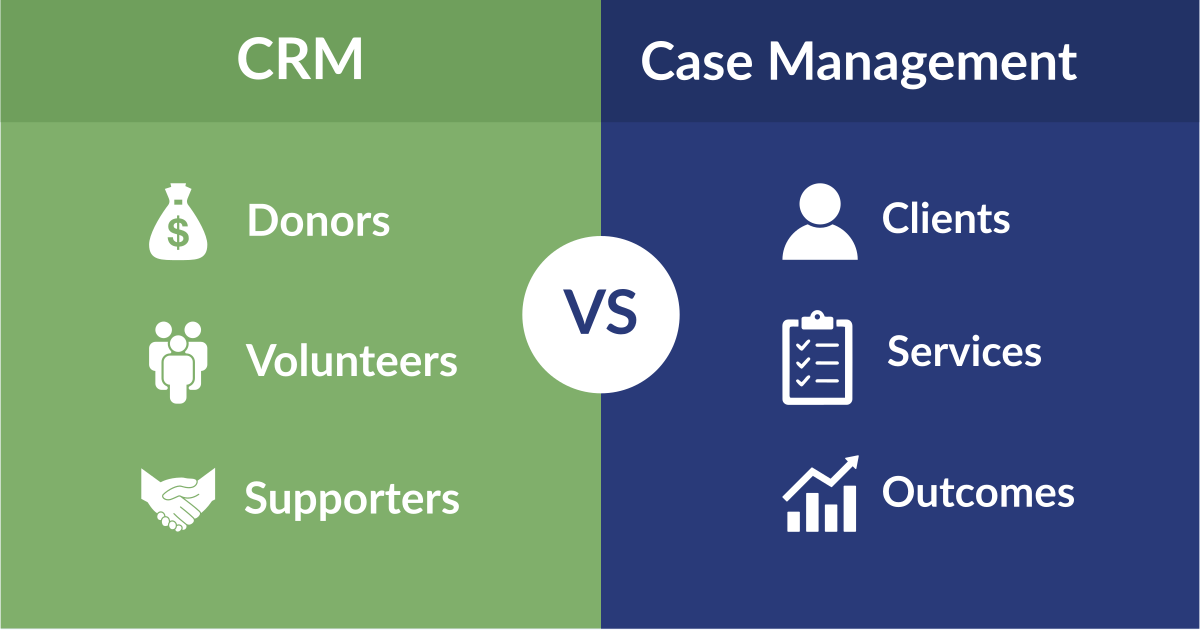
Organizations also sometimes confuse case management software with traditional CRM software. While both can store client information, case management systems are typically built around service delivery, case notes, referrals, workflows, and outcomes, while traditional CRMs are usually centered more on managing contacts and relationships.
Examples of Case Management
.svg)
Seeing how the process plays out across different sectors makes the concept easier to picture.
Housing services: A case manager assesses a client's housing instability, determines eligibility for rental or utility assistance programs, coordinates with landlords or housing authorities, documents each step, and tracks whether the client achieves stable housing.
Behavioral health: A case manager coordinates a client's treatment plan, schedules and tracks appointments, manages referrals to specialists, and monitors progress over the course of treatment.
Family services: A case manager may be managing needs across multiple family members at once, coordinating with schools, healthcare providers, and community programs to support both parents and children.
Senior services: A case manager coordinates transportation, benefits enrollment, healthcare referrals, in-home support services, and wellness check-ins for an older adult client.
Workforce development: A case manager tracks a client's skills assessments, enrollment in training programs, certification progress, job referrals, and eventual employment outcomes.
Each of these examples follows the same underlying structure even though the services being coordinated look completely different.
Common Challenges in Case Management
Even well-run programs run into recurring operational friction:
- Client information scattered across spreadsheets, paper files, and disconnected systems
- Duplicate data entry across multiple forms or platforms
- Inconsistent documentation between staff members or programs
- Difficulty tracking whether referrals actually led to services
- Missed follow-ups when a client falls out of contact
- Limited visibility into a client's full history across programs or staff
- Reporting that eats up hours of staff time before a funder deadline
- Trouble measuring outcomes consistently across different programs
None of these challenges are unusual. They're the natural result of trying to coordinate a lot of moving parts, often with limited staff time and systems that weren't built for the volume of information case management requires.
How Technology Supports Modern Case Management
Case management software exists to reduce operational friction, not to replace the judgment and relationship-building that case managers bring to their work.
At its core, a well-designed system centralizes client records across programs and staff, and cuts down on manual entry through online intake and configurable forms. Case notes and structured assessments stay tied directly to the client record, and service plans stay visible to the whole team.
The platform also supports the workflow itself. Tasks and referrals get routed to the right person, reminders catch follow-ups before they're missed, and referrals get tracked from initiation through outcome. Document management keeps paperwork organized, and permission controls make sure staff only see what they need to.
On the reporting side, dashboards serve both internal use and funder requirements, with outcomes tracked back to the goals that generated them.
The goal isn't to force every program into an identical process. A housing program and a family services program inside the same organization may need very different fields, workflows, and reporting structures, even if both are technically "case management."
What to Look for in a Case Management System
Organizations evaluating case management software tend to weigh a similar set of factors.
Configurability comes first: can the system adapt to different programs, forms, and workflows without custom development for every change? Ease of use matters just as much — a system that creates too much friction just sends staff back to spreadsheets.
Reporting flexibility determines whether funders and leadership get what they need without hours of manual work. Permissions and security determine whether sensitive client information stays protected across roles and programs.
Intake and portal capabilities reduce manual entry by letting clients or partners submit information directly. Workflow automation extends that same efficiency to tasks, referrals, and reminders.
Two more factors round it out: whether the system integrates with the organization's existing tools, and whether the vendor supports real implementation and adoption, not just the sale. For organizations running multiple programs, it's also worth asking whether one system can serve different departments' distinct needs, rather than requiring separate tools for each.
The right system, in the end, is the one that fits how the organization actually operates — not any particular feature list.
Conclusion
Case management is fundamentally about coordination. It connects a client's needs with the right services, keeps staff activity organized across a case, documents what was done, and ties all of it back to outcomes. The models and specific workflows vary by sector and population, but the underlying structure, assess, plan, connect, monitor, document, evaluate, holds up across housing, behavioral health, family services, senior services, and workforce development alike.
As organizations grow and take on more programs, more funders, and more staff, keeping that process consistent gets harder to do with spreadsheets and disconnected tools. Having the right systems in place makes it easier to manage that complexity without losing the personal, relationship-driven work at the center of case management. If you're exploring ways to bring more structure to your organization's case management process, NewOrg's case management software is built to support exactly that, and you're welcome to request a demo to see how it fits your programs.
.svg)