
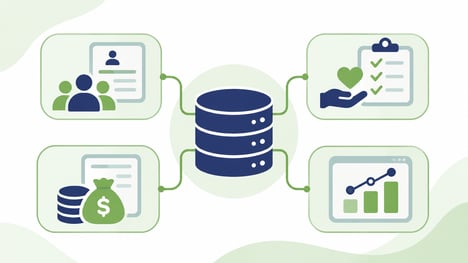
 Nonprofits collect information across client intake, service delivery, program outcomes, grant reporting, and daily operations. But when that information is stored in separate spreadsheets, systems, or files, answering questions across programs can become difficult.
Effective nonprofit data management helps organizations maintain accurate records, connect information across services, protect sensitive data, and produce reliable reports.
This guide covers practical nonprofit data management best practices, from establishing consistent definitions and improving data quality to connecting program records, simplifying reporting, and selecting appropriate software.
What is nonprofit data management?
Nonprofit data management is the process of collecting, organizing, maintaining, protecting, and using information about clients, programs, services, funding, and outcomes. It helps organizations maintain reliable records, coordinate services, meet reporting requirements, and make informed decisions. Effective data management also establishes consistent definitions, clear responsibilities, appropriate access permissions, and processes for maintaining data quality.
Data management involves more than storing records in a database or organizing files in a shared drive. It establishes how information is collected, connected, reviewed, and used throughout an organization.
For human services nonprofits, this means ensuring that client information, service delivery records, funding requirements, and program outcomes can be understood together.
What types of data do nonprofits manage?
Nonprofits typically manage five categories of information: client and participant data, program and service data, outcome data, funding and grant data, and operational data. Each supports different activities, from coordinating services to evaluating program performance. Understanding these categories helps organizations identify which information they need, how it should be organized, and where different records connect.
Nonprofit client data often requires particular attention because it may include sensitive personal information. Nonprofit program data provides context about services delivered, while outcome data helps organizations evaluate results rather than simply count activities.
Connecting these categories makes it easier to understand program performance and prepare consistent reports.
Why does nonprofit data become fragmented?
Nonprofit data often becomes fragmented as organizations expand programs, adopt new tools, and respond to different reporting requirements. A program may introduce its own spreadsheet, a funder may request additional information, or a department may need specialized software. These decisions meet immediate needs but can gradually create separate sources of information that are difficult to connect.
Common challenges include duplicate records, inconsistent definitions, limited visibility across programs, and manual reporting.
Common Nonprofit Data Management Challenges
Data fragmentation can affect nonprofits in several ways:
- Information collected by external partners: Household or client data may be difficult to access when needed for service coordination or reporting.
- Separate systems across programs: Different departments may maintain records that are difficult to connect.
- Spreadsheets and paper-based records: Staff may need to manually consolidate information from multiple sources.
- Changing reporting requirements: Existing fields and workflows may not capture information needed by new funders or programs.
These challenges often reflect how systems have developed over time rather than problems with individual staff practices.
The goal is not necessarily to replace every existing tool, but to establish a consistent approach to organizing information and maintaining reliable records.

What is the difference between collecting data and managing data?
Data collection is the act of gathering information, such as recording client demographics, assessments, or services delivered. Data management is the broader process of defining, organizing, maintaining, protecting, and using that information. A nonprofit can collect extensive data without having consistent definitions, reliable records, or an efficient way to turn the information into useful reports.
Effective data management addresses five questions:
- What information needs to be collected?
- Why is that information necessary?
- Where should it be stored?
- Who is responsible for maintaining it?
- How will it be used?
Every field should support a clear purpose, such as service delivery, program management, compliance, funding, or outcome measurement.
When a field has no defined purpose, organizations should evaluate whether it is necessary. Collecting only useful information can simplify data entry and make records easier to maintain.
How do you create consistent data definitions?
Create consistent data definitions by developing a shared data dictionary that identifies important fields, explains what each means, and assigns responsibility for maintaining the definition. Start with fields frequently used in reporting, such as active clients, completed referrals, and services delivered. Shared definitions help staff collect comparable information across programs and reporting periods.
Consider the definition of a completed referral.
One program might count a referral as completed when it is sent to another organization. Another might count it only after confirming that the client connected with the receiving provider.
Both measures can be useful, but they represent different activities. Combining them without a shared definition can produce misleading totals.
Sample Nonprofit Data Dictionary
These definitions are examples, not universal standards. Organizations should adapt them to their programs, reporting requirements, and funder definitions.
A data dictionary also provides a useful reference when updating forms, onboarding staff, or introducing a new nonprofit data management system.
How do you reduce duplicate and incomplete records?
Reduce duplicate records by checking whether a client already exists before creating a new record, establishing consistent entry formats, and reviewing possible duplicates regularly. Improve completeness by identifying the information required for identification, service delivery, and reporting. Nonprofit data quality improves when essential fields are standardized without requiring staff to collect unnecessary information.
Duplicate records may appear when names are entered differently, clients participate in multiple programs, or information is imported from another system. They can affect client counts and make service histories harder to review.
Incomplete records present a related challenge. Requiring too many fields increases administrative work, while leaving essential information optional may limit reporting accuracy.
A practical approach is to distinguish between:
- Required fields: Information necessary for identification, eligibility, service delivery, or reporting.
- Program-specific fields: Information needed only by particular services or departments.
- Optional fields: Additional context that is not necessary for every record.
These standards help maintain reliable nonprofit database management practices without making data entry unnecessarily complicated.
How do you connect data across programs?
Connect data across programs by using shared client records that link relevant services, assessments, referrals, and case activity while allowing each program to maintain its own workflows. This approach helps authorized staff understand a client's service history without requiring identical forms or processes across departments. Appropriate permissions determine which information different teams can access.
Consider a client receiving housing assistance, employment support, and utility assistance.
If each program maintains a separate record, staff may have difficulty identifying previous services or coordinating next steps. Connected records provide a more complete understanding of a client's involvement across programs, subject to privacy requirements.
JFCS Louisville provides an example of this approach. After leaving a previous platform whose rising costs and limited functionality restricted data management and reporting, the organization brought its clinical, career, older adult and caregiver, and family stability programs onto one platform.
A custom caseload tab supports multiple case managers working with the same client, accommodating different program responsibilities within a shared system.
This illustrates an important distinction between case management in human services and a general-purpose CRM. Connected service records need to support ongoing client relationships and program activity, often beginning with client intake.
How do you build data collection into existing workflows?
Build data collection into existing workflows by capturing information during activities staff already perform, such as intake, assessments, service delivery, referrals, and case closure. When records are updated at the point of service, the same information can support daily operations and reporting. This reduces the need to maintain separate reporting files or repeatedly enter similar details.
For example, a program might record a completed service in a client record and then manually enter the same information into a grant reporting spreadsheet.
A connected approach allows the original service record to provide the information needed for reporting, provided the required fields are captured consistently.
Organizations can identify opportunities to simplify collection by reviewing when information is entered, where it is stored, and which reports depend on it.
Well-structured case notes and a consistent intake process help make documentation useful for both service coordination and reporting.

What makes nonprofit data high quality?
High-quality nonprofit data is accurate, complete, consistent, current, and relevant to its intended purpose. Accurate records reflect what occurred, complete records contain necessary information, and consistent records follow shared definitions. Current information remains useful for decisions, while relevant information serves an identifiable need. These qualities help nonprofits produce dependable reports and make informed program decisions.
The five qualities work together. A record may contain every required field but still create reporting problems if those fields use inconsistent definitions.
Nonprofit data quality management should include regular checks for:
- Missing required information
- Potential duplicate records
- Outdated client or program details
- Inconsistent field values
- Records that do not follow established definitions
A quarterly review may be a manageable starting point, although the appropriate frequency depends on program activity, reporting deadlines, and the sensitivity of the information.
The objective is to maintain data staff can use confidently without introducing unnecessary administrative work.
Who should have access to nonprofit client data?
Access to nonprofit client data should be based on job responsibilities, the sensitivity of the information, and applicable privacy requirements. Staff should have access to the records necessary for their work rather than unrestricted access to all information. Role-based permissions, appropriate authentication, and audit logging can help organizations protect sensitive records and maintain accountability.
For example, a case manager may need detailed service records, while a finance staff member may need funding or billing information. Leadership may need summary dashboards without access to every individual case note.
Two important principles are:
- Role-based access: Permissions are assigned according to responsibilities.
- Least-privilege access: Staff receive only the permissions necessary for their work.
Nonprofit data security also involves reviewing permissions when responsibilities change and establishing procedures for handling sensitive information.
For organizations that handle protected health information, HIPAA compliance in human services adds specific requirements. Other nonprofits may have different legal, contractual, or funding-related privacy obligations
Access policies should reflect the information an organization maintains and the requirements that apply to it.
How do you design data collection for reporting?
Design data collection by starting with the questions that funders, leadership, boards, and program staff need answered. Identify the measures required for each report, define the underlying fields, and determine when information will be recorded. This approach helps ensure that service documentation contains the data needed for nonprofit data reporting before a reporting deadline arrives.
Common reporting measures include:
- Clients or households served
- Services delivered
- Referrals completed
- Program participation
- Outcomes achieved
- Results by funding source
- Results by program or service location
Each measure depends on consistent definitions and information collected during program activities.
Community Frameworks, an affordable housing organization in Washington State, encountered a related challenge across nine rental properties. Third-party property managers collected household information, making internal case management and grant reporting difficult.
The Community Frameworks case study illustrates why access to relevant household and service information matters when organizations need to coordinate programs and meet reporting requirements.
Consolidating information can also improve reporting efficiency.
At the Métis Nation of Alberta, compiling information from separate spreadsheets and tools previously took 3 to 4 hours. After consolidating the information in NewOrg, the same work takes under 30 minutes.
This documented result demonstrates the benefit achieved in that implementation, rather than an expected outcome for every nonprofit.
The challenge extends beyond individual organizations. In a 2025 survey conducted for California's Little Hoover Commission, 65.3% of responding nonprofit state grant or contract recipients identified burdensome reporting requirements as a challenge. The finding highlights the importance of collecting and organizing information consistently so nonprofits can meet funder requirements without unnecessary administrative work.
Whether an organization is preparing a grant report, developing an outcomes measurement plan, or producing an impact report, reliable reporting begins with information that has been consistently defined and collected.
How can nonprofits use data to improve programs?
Nonprofits can use connected, reliable data to identify service patterns, evaluate program outcomes, and guide operational decisions. By comparing information across programs, reporting periods, and participant groups, organizations can identify where additional support may be needed. The goal is to move beyond documenting activities and use the information collected to improve service delivery.
For example, organizations may examine:
- Which referral partners have higher completion rates
- Where clients experience delays during intake
- Which services have lower participation or completion rates
- Whether particular communities have unmet service needs
- How outcomes differ across programs or participant groups
These findings can inform changes to outreach, staffing, referral processes, program design, or follow-up procedures.
However, patterns should be interpreted in context. A higher completion rate does not necessarily mean a service caused better outcomes, particularly when programs support populations with different needs.
Combining nonprofit program data with staff observations and participant feedback can provide a more complete understanding of program performance.
When do spreadsheets start to create problems?
Spreadsheets can become difficult to manage when multiple staff need to update records, different users require different access permissions, or information must be connected across programs. They can also create additional reporting work when data is maintained in separate files. For smaller programs with straightforward requirements, however, a well-managed spreadsheet may remain entirely appropriate.
Signs that an organization may need a more structured system include:
- Repeated entry of the same information
- Difficulty identifying duplicate client records
- Limited visibility across programs
- Manual consolidation of reporting files
- Challenges managing access to sensitive records
- Increasing dependence on individual spreadsheets
As requirements grow, organizations may consider nonprofit data management software, a nonprofit CRM, or a purpose-built case management platform.
The right choice depends on the complexity of the organization's services, data relationships, reporting requirements, and security needs.
What should you look for in a nonprofit data management system?
A nonprofit data management system should support configurable forms and workflows, connected records, reliable reporting, appropriate security controls, and data quality management. It should also accommodate differences between programs without requiring unnecessary duplication. When evaluating software, nonprofits should consider implementation assistance, data migration, integrations, and whether the platform can adapt as organizational requirements change.
A nonprofit database management system should be evaluated on more than the number of features it offers. Organizations should consider how well it supports existing services and reporting needs.
Before changing platforms, it is also important to review the quality of existing records, identify reporting definitions, and plan how information will transfer into the new system.
Ongoing support, maintenance requirements, and the ability to accommodate future changes should also influence the decision.
How does technology support better nonprofit data management?
Technology supports nonprofit data management by providing a consistent place to maintain records, apply data standards, control access, and generate reports. A configurable platform can connect client information with program activities and outcomes while accommodating different workflows. However, software works best when organizations have defined what they collect, how records should be maintained, and who is responsible.
NewOrg is a cloud-based data and case management platform that helps nonprofits manage client data, service delivery, and reporting more efficiently. NewOrg has served nonprofits and government agencies since 2006.
Its platform supports configurable fields, forms, assessments, workflows, client records, document management, role-based permissions, and reporting.
These capabilities help human services organizations maintain information across different programs while supporting their individual processes.
Technology does not eliminate the need for consistent definitions, data ownership, or quality reviews. Instead, it provides tools to put those practices into operation.
What is a simple nonprofit data management framework?
A practical nonprofit data management framework includes seven steps: identify existing data, clarify its purpose, establish consistent definitions, reduce duplicate collection, control access, review data quality, and use information for decisions. Organizations can introduce these improvements gradually, starting with one program, reporting requirement, or frequently used field rather than redesigning every process at once.
Seven Steps to Better Nonprofit Data Management
These nonprofit data management best practices offer a manageable starting point for improving existing processes.
For example, reviewing a single grant report can reveal which fields are essential, whether definitions are consistent, and where information is being collected more than once.
Small, targeted improvements can establish a stronger foundation for future reporting and program management.
Conclusion
Effective nonprofit data management is not about collecting more information. It is about maintaining reliable connections between clients, programs, services, funding, outcomes, and decisions.
Consistent definitions, connected records, appropriate security controls, and regular data quality reviews help organizations coordinate services and prepare more dependable reports.
For nonprofits managing multiple programs, the right technology can make these practices easier to maintain.
Looking for a more connected approach to nonprofit data management? Explore how NewOrg helps nonprofits organize client information, manage services across programs, and simplify reporting with a configurable, cloud-based platform.