 CARF accreditation evaluates how organizations deliver services, document their practices, and measure results. For case management programs, client records provide important evidence of service delivery, from intake assessments and individualized service plans to referrals, case notes, and progress reviews. The challenge is ensuring those records are consistent, connected, and accessible when needed.
This guide provides a practical documentation checklist, a readiness tracker, and worked examples to help case management teams organize client records, identify documentation gaps, and prepare outcome data for CARF accreditation.
What Is CARF Accreditation?
CARF International, originally established as the Commission on Accreditation of Rehabilitation Facilities, is an independent nonprofit organization that accredits health and human services providers.
Through its accreditation process, CARF evaluates whether an organization's programs and practices conform to established quality standards. Its framework emphasizes person-centered services, organizational accountability, performance measurement, and continuous improvement.
CARF accredits a range of programs, including behavioral health, substance use treatment, employment and community services, child and youth services, and medical rehabilitation.
CARF's Behavioral Health accreditation area includes Case Management/Services Coordination as a distinct program. However, case management activities may also be incorporated into other accredited services. The applicable standards depend on the specific programs and services an organization is seeking to accredit.
How Does the CARF Accreditation Process Work?
CARF outlines nine steps in its official accreditation process. For organizations preparing their documentation, those steps can be grouped into five broader phases.
1. Identify Applicable Standards
Determine which programs and services will be accredited and obtain the appropriate CARF standards manual. CARF provides guidance to help organizations identify the standards that apply to their services.
2. Conduct a Self-Evaluation
Review organizational practices, documentation, and performance against the applicable standards. This process helps identify gaps, evaluate readiness, and prioritize improvements before a survey.
3. Apply for an Accreditation Survey
Submit an application identifying the organization's programs, locations, leadership information, and requested survey timeframe. CARF then coordinates survey fees, scheduling, and survey-team selection.
4. Complete the Accreditation Survey
CARF surveyors assess conformance with applicable standards by reviewing documentation, observing services, and interviewing staff, persons served, and other stakeholders. The survey evaluates how organizational practices align with the standards, not simply whether documents exist.
5. Address Findings and Maintain Accreditation
Following the survey, CARF issues an accreditation decision and provides a report identifying findings and opportunities for improvement. Organizations must submit a Quality Improvement Plan within 90 days of notification of the accreditation decision. Organizations that achieve accreditation also submit an Annual Conformance to Quality Report as part of maintaining accreditation. CARF notes that the process may involve a year or more of preparation before the survey, followed by ongoing improvement efforts.
For the complete nine-step process, visit CARF's official accreditation guide.
What Documentation Should Case Management Programs Review for CARF Accreditation?
Documentation helps demonstrate how an organization translates its policies and program objectives into actual services. For case management programs, accreditation preparation often involves reviewing two broad categories of information. Organizational documentation provides evidence of how policies, staff responsibilities, organizational oversight, risk management, quality monitoring, and improvement processes are maintained.
Individual service records show how the organization assesses needs, develops plans, coordinates services, and monitors progress for the people it serves. Both are important. While this guide focuses primarily on case management records, accreditation readiness also involves reviewing the organizational and administrative requirements contained in the applicable standards manual.
CARF Accreditation Documentation Readiness Checklist
Use the following checklist to identify and organize documentation before an accreditation survey.
This is an illustrative preparation checklist, not an official CARF standards checklist. Documentation requirements vary by program and accreditation area. Organizations should use the current applicable CARF standards manual and survey preparation workbook to identify specific requirements.
How to Turn the Checklist Into a Readiness Tracker
A checklist becomes more useful when an organization can identify which records have been reviewed, who is responsible, and what still needs attention.
For example:
Organizations can expand this tracker by adding the applicable CARF standard, evidence location, review date, and assigned deadline. This turns accreditation preparation from an informal document-gathering exercise into a more organized process with clear responsibilities.
What Does Well-Organized Case Management Documentation Look Like?
One way to evaluate documentation readiness is to follow a client record through the case management process, from initial assessment and service planning to follow-up and outcome measurement. Consider a hypothetical community behavioral health organization that provides case management to individuals experiencing housing instability.
A participant enters the program seeking assistance with stable housing and access to community resources. The organization collects information through several stages of service delivery.
Step 1: Intake and Assessment
The case manager begins the client intake and assessment process by documenting the participant's housing situation, immediate needs, available supports, and barriers to stability.
This information establishes a starting point for service planning.
Example documentation:
- Current housing situation: Temporary accommodation
- Identified need: Stable long-term housing
- Primary barrier: Limited income and difficulty identifying available housing
- Participant preference: Independent housing near public transportation
The assessment provides context for understanding why particular services may be appropriate.
Step 2: Individualized Service Planning
The case manager and participant develop a service plan focused on improving housing stability.
Rather than documenting a broad goal such as "improve living situation," the plan identifies specific actions, responsibilities, and follow-up expectations.
A structured plan helps connect services to the individual's identified needs.
Step 3: Service Delivery and Case Notes
As services are provided, case management notes document actions taken, interactions with the participant, and follow-up responsibilities.
A note stating only "assisted client with housing" provides limited information about what occurred.
A more useful example might read:
Met with participant to review available housing assistance options. Completed a referral to a local housing navigation program and reviewed documentation needed for the application. Participant agreed to provide income verification before the next appointment. Follow-up scheduled to review application status and identify any remaining barriers.
This example identifies the reason for the interaction, what occurred, the participant's response, and what should happen next.
Actual documentation should also include relevant administrative details, such as the service date and responsible staff member, according to the organization's policies and applicable requirements.
Step 4: Progress Review and Follow-Up
As the participant progresses, the case manager records changes in circumstances and updates the service plan when appropriate.
For example, the participant may complete an application but encounter delays obtaining required documentation.
A progress review should help explain whether the original plan remains appropriate, what barriers remain, and which actions need to change.
Step 5: Outcome Measurement
At a defined follow-up point, the organization evaluates the participant's housing situation.
The record might indicate that the participant has obtained stable housing, remains in temporary accommodation, or could not be reached for follow-up.
These results provide information about progress toward the original goal.
Importantly, organizations should distinguish between a documented negative outcome and an outcome that could not be determined because follow-up information was unavailable.
Why the Connections Between Records Matter
Each document serves a different purpose, but together they help explain the full service process.
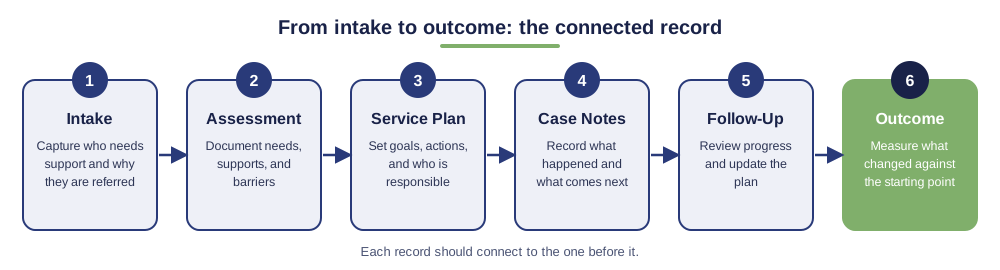
Intake → Assessment → Service Plan → Case Notes → Follow-Up → Outcome
An assessment identifies a need. The service plan establishes a response. Case notes document the work performed, while follow-up records and outcome information help explain what changed.
When this information is scattered across different systems or documented inconsistently, reconstructing the complete service history becomes more difficult.
Connected documentation makes it easier for staff, supervisors, and reviewers to understand how services were delivered and evaluated.
How to Review Client Records for Documentation Gaps
Before an accreditation survey, organizations can conduct internal record reviews to identify inconsistencies and opportunities for improvement.
Rather than checking only whether a document exists, review whether the information provides a clear and accurate picture of services delivered.
A program supervisor could select a sample of records using a consistent internal review method and examine five questions.
1. Is the Assessment Complete?
Does the record document the individual's identified needs, preferences, and relevant circumstances?
2. Does the Service Plan Connect to the Assessment?
Are goals and planned services related to the needs identified during assessment?
3. Are Services Documented Clearly?
Can a reviewer understand what occurred, when it happened, who was involved, and what follow-up was planned?
4. Is Progress Evaluated?
Are there records of follow-up, changes in circumstances, and service plan updates?
5. Are Outcomes Recorded Consistently?
Can the organization determine what progress was made using clearly defined measures?
These reviews can reveal gaps that are difficult to identify when examining individual forms separately.
For example, an organization may discover that every reviewed client has a service plan, but several records lack updates explaining how goals changed after reassessment.
Supervisors could respond by clarifying documentation expectations, providing additional training, and establishing recurring record reviews.
The purpose is not simply to prepare for a survey. It is to strengthen documentation quality and service continuity.
Internal reviews should use appropriately authorized access and protect confidential client information.
How Outcome Measurement Supports CARF Accreditation Readiness
Service documentation helps explain what happened during an individual client's experience. Outcome measurement provides another perspective by helping organizations evaluate results across their programs.
CARF's accreditation framework emphasizes performance measurement, management, and continuous improvement.
For case management programs, outcome measurement can help connect the services provided with changes in the circumstances of the people receiving them.
Example: Measuring Housing Stability Outcomes
Consider the same hypothetical behavioral health organization. The program wants to determine how many participants achieve stable housing after receiving services.
Rather than reporting only how many housing referrals were completed, the organization distinguishes between outputs and outcomes by measuring whether participants achieve stable housing.
The definition of stable housing should be established before data collection and applied consistently.
If the program wants to measure whether participants maintain stable housing over time, it would need additional information about housing continuity during the measurement period.
Turning Outcome Data Into Meaningful Results
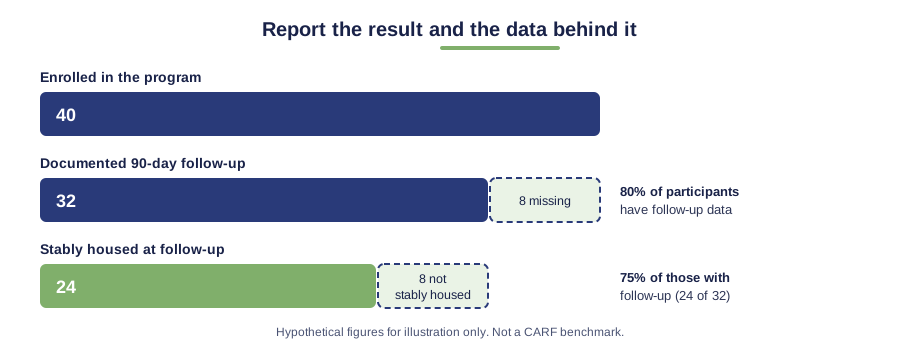
Suppose 40 participants enroll in the program. At the 90-day follow-up, the organization reviews their housing outcomes to determine how many have achieved stable housing and whether complete follow-up information is available.
What Do These Results Tell Us?
While 75% of participants with documented follow-up were stably housed, this figure doesn't represent the entire group. Eight participants have no documented follow-up outcome, meaning their housing status remains unknown.
This distinction matters because missing information can affect how program results are interpreted. An organization that reports only successful outcomes without accounting for incomplete follow-up data may present an overly positive picture of its performance.
Examining both outcomes and data completeness provides a more accurate understanding of program effectiveness and helps identify areas that may need additional attenti
All figures in this example are hypothetical. They illustrate an outcome measurement approach, not a CARF-required performance benchmark.
Using Outcome Data for Continuous Improvement
The value of outcome data comes from what an organization does with the results. A consistent nonprofit outcome measurement framework can help organizations turn collected information into meaningful improvements.
For example, staff may discover that participants who miss follow-up appointments are more likely to have undocumented housing outcomes.
The organization could introduce a more consistent follow-up process, assign responsibility for contacting participants, and monitor whether documentation completeness improves.
This creates a cycle of improvement:
Collect Data → Review Results → Identify Gaps → Make Improvements → Measure Again
Organizations can use this approach to evaluate service delivery, identify recurring barriers, and make informed decisions about program improvements.
Common CARF Accreditation Preparation Challenges for Case Management Programs
Even organizations with established documentation practices may encounter difficulties when preparing for accreditation.
Inconsistent Records Across Staff and Programs
When case managers use different formats or terminology, reviewing information consistently becomes more difficult.
Standardized documentation expectations can improve record quality while still allowing flexibility for different programs and client needs.
Service Plans That Are Not Regularly Updated
A service plan may have been appropriate when created but no longer reflect the individual's circumstances.
Organizations should review whether their documentation practices support updates when goals, needs, or services change.
Disconnected Documentation and Reporting
When assessments, case notes, and outcome data are maintained in separate systems, staff may spend additional time combining information for reviews and reporting.
Consistent data sources and clearly defined workflows can reduce this burden.
Collecting Data Without Using It
Programs may collect substantial amounts of information without regularly evaluating what it reveals.
Outcome reports become more useful when findings are reviewed, discussed, and connected to improvement actions.
Treating Accreditation as a One-Time Project
Preparing documents immediately before a survey may address short-term gaps without establishing reliable ongoing processes.
Recurring record reviews, updated policies, staff training, and performance monitoring can help organizations maintain readiness over time.
How Case Management Software Supports CARF Accreditation Preparation
Many accreditation preparation challenges involve how organizations collect, organize, and review information. A configurable case management platform like NewOrg can support consistent documentation practices across the service process.
Intake and Assessment
Configurable forms and workflows help organizations collect information consistently while accommodating different program requirements.
Service Plans and Goals
Individualized goals, planned services, and progress updates can be maintained alongside related client information. This helps staff follow how a person's needs and service plan change over time.
Case Notes and Referrals
Case notes, assessments, service plans, and related documents can be organized within connected client records. Tasks, referrals, and scheduled reviews can also support coordination and follow-up activities.
Outcomes and Reporting
When configured to capture the necessary information consistently, NewOrg can help organizations aggregate client-level data into reports and dashboards.
For example, housing status collected at intake and follow-up can support nonprofit impact reporting without requiring staff to manually review every individual record.
The accuracy of these reports depends on the organization's configuration, data collection practices, and the completeness of the information recorded.
Access and Accountability
Configurable permissions help organizations make information available to authorized personnel based on their responsibilities.
These capabilities can support more organized documentation and simplify internal review processes.
However, case management software does not establish conformance with CARF standards or guarantee accreditation.
Organizations remain responsible for implementing appropriate policies, service practices, oversight, and quality improvement activities.
Final CARF Accreditation Documentation Readiness Checklist
Before an accreditation survey, organizations can use the following questions as a final internal review.
- Applicable standards: Have we identified the correct standards manual and confirmed which programs and services are seeking accreditation?
- Organizational practices: Do our policies reflect how services and administrative processes actually operate?
- Client documentation: Are assessments, service plans, case notes, and follow-up records complete and consistent?
- Individual progress: Can we explain how services respond to identified needs and how progress is reviewed?
- Outcome measurement: Are measures clearly defined, collected consistently, and analyzed appropriately?
- Quality improvement: Can we demonstrate how findings are reviewed, improvement actions are assigned, and results are evaluated?
- Documentation access: Can authorized staff locate relevant information when needed?
- Ongoing readiness: Have we established procedures for continuing documentation reviews and performance monitoring?
These questions can help guide internal preparation, but they do not replace a review against the applicable CARF standards.
CARF publishes standards manuals and survey preparation workbooks to help organizations understand requirements and evaluate readiness.
For Behavioral Health surveys conducted between July 1, 2026, and June 30, 2027, the 2026 Behavioral Health Standards Manual and Survey Preparation Workbook provide the applicable standards, documentation guidance, and preparation questions.
The manual includes appendices addressing required written documentation and operational timelines.
Organizations seeking accreditation in other service areas should obtain the current manual applicable to their programs.